
Charlotte Scott Centre for Algebra
School of Engineering and Physical Sciences, University of Lincoln
Paper by Simon Smith and Australia-based mathematician Colin Reid published in one of the top maths journals: Mathematische Annalen
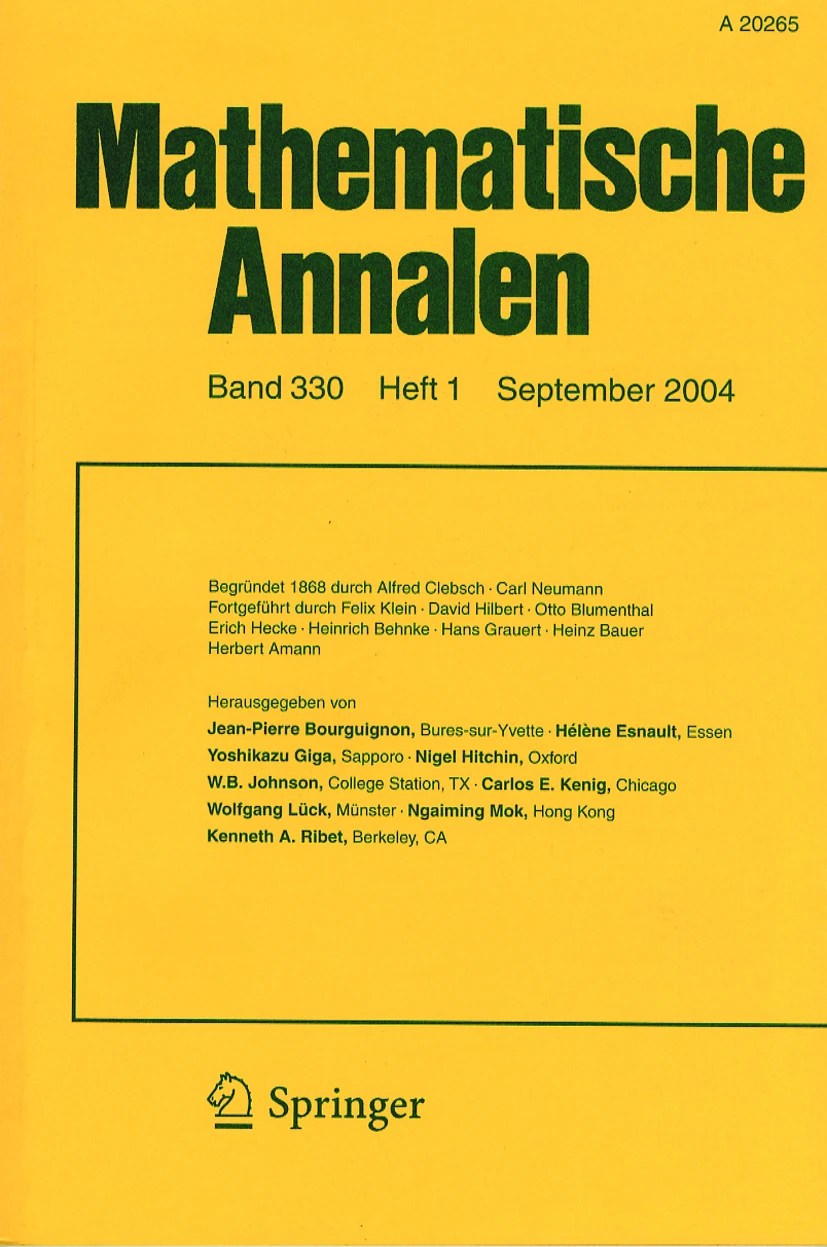
Colin Reid and Simon Smith have spent several years developing a new theory for groups acting on trees they call the theory of local action diagrams. The paper in which their theory is described has just been published this month in the journal Mathematische Annalen (usually abbreviated to Math. Ann).
Groups acting on trees appear throughout pure mathematics. In a sense the study of symmetry of finite objects is embedded within the study of groups acting on trees, and groups acting on trees form one of the main tools we have to understand the symmetries of infinite objects. The field has deep applications to our understanding of shape and space.
The main tool for studying groups acting on trees has until recently been the iconic Bass-Serre theory. However, Bass-Serre theory has been shown to be of limited use in certain new and rapidly developing areas of pure mathematics (particularly, “tdlc theory”). Recently new techniques for studying groups acting on trees have appeared that are built around notions of “independence” and “local-to-global” universal constructions. The theory of local action diagrams incorporates into one unifying framework various notions including independence (in the sense of J. Tits’ property (P)) and foundational local-to-global universal constructions:
- The Burger-Mozes groups constructed by Marc Burger and Shahar Mozes in their 2000 paper in Publ. Math. IHÉS.
- The box product construction by Simon Smith in his 2017 paper in Duke Math. J.
Simon Smith showcased this new theory when he was plenary speaker at the last Groups St Andrews conference back in 2022 (one of the oldest and largest group theory conferences in the world that takes place approximately every four years), when this paper was still in preprint form. Now the paper, entitled Groups acting on trees with Tits’ independence property (P) has been published open access and can be found here: https://doi.org/10.1007/s00208-026-03412-w
The journal Mathematische Annalen is one of the most prestigious journals in pure mathematics. Former editors include David Hilbert and Albert Einstein.

